WELCOME TO LAB-ELITE
ASTM C114 chapter 19
ASTM C114 ALKALI ANALYSIS OF CEMENT AND CEMENTITIOUS MATERIALS
LAB-ELITE provides ASTM C114 alkali testing services for cement and cementitious materials, with determination of sodium and potassium for material characterization and quality control.
Alkali analysis can provide valuable supporting data for durability investigations, cement characterization and alkali-silica reaction (ASR) assessments.
Our laboratory combines advanced analytical instrumentation, technical expertise and engineering-focused interpretation to support material qualification, forensic investigations and infrastructure projects.
ASTM C114 alkali analysis can support applications including:
- cement quality control
- ASR investigations
- Aggregate reactivity studies
- Supplementary cementitious materials
- Concrete durability assessments
- Forensic engineering projects
- Research and development
WHY ALKALIS ARE IMPORTANT IN CONCRETE
Alkalis play an important role in the performance and durability of concrete.
Although sodium and potassium compounds are naturally present in many cements, elevated alkali levels may contribute to deleterious reactions when reactive aggregates are present.
Understanding alkali content helps engineers and material producers:
- evaluate durability risks
- verify compliance with specifications
- assess material suitability
- support long-term infrastructure performance

ALKALI-SILICA REACTION (ASR)
One of the primary reasons alkali testing is performed is to evaluate potential risks associated with Alkali-Silica Reaction (ASR).
ASR is a deterioration mechanism that occurs when:
- reactive silica minerals
- alkalis
- moisture
are present simultaneously within concrete.
The resulting reaction may produce an expansive gel capable of generating internal stresses within the concrete.
Potential consequences include:
- map cracking
- expansion
- loss of durability
- reduced service life
- costly repairs

SODIUM OXIDE EQUIVALENT (Na₂Oeq)
In cement and concrete investigations, alkali content is often expressed as Sodium Oxide Equivalent (Na₂Oeq).
This value provides a standardized means of evaluating the combined contribution of sodium and potassium to total alkali content.
Na₂Oeq is commonly referenced in:
- cement specifications
- aggregate reactivity studies
- ASR investigations
- durability assessments
- infrastructure projects

Example of chloride material exposure
CEMENT QUALITY CONTROL
ASTM C114 alkali analysis is routinely used by cement producers and laboratories for quality control purposes.
Alkali monitoring may support:
- production consistency
- specification compliance
- process optimization
- customer requirements
- certification programs
Routine alkali testing helps verify that production materials remain within targeted chemical composition ranges.

SUPPLEMENTARY CEMENTITIOUS MATERIALS
ASTM C114 alkali analysis may also be applied to supplementary cementitious materials such as:
- fly ash
- slag cement
- natural pozzolans
- calcined clays
- blended cements
Understanding alkali contribution from supplementary materials can be important when evaluating total concrete mixture performance.

CONCRETE DURABILITY INVESTIGATIONS
ASTM C114 alkali analysis is frequently performed during forensic engineering and durability investigations.
Typical applications include:
- ASR investigations
- material qualification studies
- concrete deterioration assessments
- rehabilitation planning
- litigation support
- expert witness projects
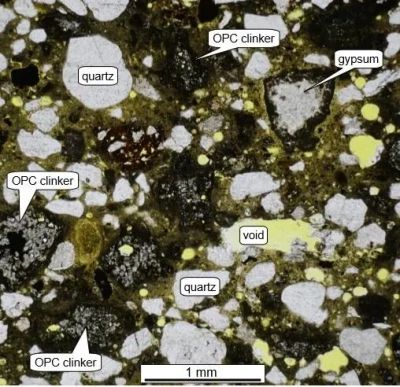
Alkali content data is often interpreted together with petrographic and mineralogical findings.
ASTM C114 ANALYTICAL SERVICES
At LAB-ELITE, ASTM C114 alkali investigations may include:
- sodium oxide determination
- potassium oxide determination
- sodium oxide equivalent calculations
- cement characterization
- supplementary cementitious material analysis
- durability investigations
- forensic engineering support
- quality control testing
ASTM C114 results may be combined with:
- ASTM C1260
- ASTM C1293
- XRF characterization
- XRD characterization
- petrographic examination
- aggregate testing

COMMON APPLICATIONS OF ASTM C114 ALKALI TESTING
ASTM C114 alkali testing is frequently requested by:
- cement manufacturers
- concrete producers
- consulting engineers
- aggregate producers
- municipalities
- transportation agencies
- forensic consultants
- research organizations
Typical projects include:
- cement qualification
- ASR evaluations
- aggregate reactivity investigations
- infrastructure projects
- durability studies
- material certification programs

WHEN SHOULD TOTAL ALKALIS OR WATER-SOLUBLE ALKALIS BE MEASURED?
ASTM C114 provides two different approaches for alkali determination depending on the objective of the investigation.
Although both methods quantify sodium and potassium compounds, they provide different information regarding the material being evaluated.
ASTM C114 Section 19.1 – Total Alkalis
Purpose
Section 19.1 determines the total alkali content present within the material.
The analysis measures all sodium and potassium compounds regardless of whether they are immediately available for dissolution or reaction.
Results are typically reported as:
- Sodium Oxide (Na₂O)
- Potassium Oxide (K₂O)
- Sodium Oxide Equivalent (Na₂Oeq)
When Total Alkalis Should Be Used
Total alkali determination is generally recommended for:
- Cement certification
- Cement quality control
- Cement specification compliance
- Alkali-Silica Reaction (ASR) risk assessment
- Supplementary cementitious material characterization
- Material qualification studies
- Research and development projects
Why Total Alkalis Matter
In concrete durability investigations, the total alkali content represents the maximum alkali inventory potentially available within the cementitious system over the service life of the structure.
For this reason, most cement specifications and ASR evaluations rely on total alkali content rather than water-soluble alkalis.
ASTM C114 Section 19.2 – Water-Soluble Alkalis
Purpose
Section 19.2 determines only the fraction of alkalis that readily dissolve in water under the extraction conditions specified by the method.
The analysis measures the immediately available or readily soluble alkali fraction.
When Water-Soluble Alkalis Should Be Used
Water-soluble alkali determination may be useful for:
- Cement hydration studies
- Alkali release investigations
- Research applications
- Early-age concrete performance studies
- Cement chemistry investigations
- Academic research projects
Why Water-Soluble Alkalis Matter
Water-soluble alkalis represent the portion most likely to enter the pore solution rapidly after mixing and may therefore influence early-age chemical reactions.
However, water-soluble alkalis do not represent the total alkali inventory contained within the material.
TOTAL ALKALIS VS WATER-SOLUBLE ALKALIS
ParameterASTM C114 Section 19.1ASTM C114 Section 19.2MeasuresTotal alkalisWater-soluble alkalisReportsNa₂O, K₂O, Na₂OeqSoluble Na₂O and K₂OTypical UseCement specificationsResearch and cement chemistryASR EvaluationsRecommendedGenerally not used aloneCement CertificationRecommendedNot typically specifiedQuality ControlWidely usedSpecialized applicationsRepresents Maximum Alkali InventoryYesNoRepresents Immediately Available AlkalisNoYes
Which Method Should Be Selected?
For most engineering, construction and infrastructure projects, ASTM C114 Section 19.1 (Total Alkalis) is the preferred method because it is the basis for:
- Cement specifications
- ASTM and CSA requirements
- ASR evaluations
- Material qualification programs
- Infrastructure durability assessments
ASTM C114 Section 19.2 (Water-Soluble Alkalis) is generally reserved for specialized research, cement chemistry studies and investigations where alkali release behavior is of particular interest.
Lab-Elite Recommendation
When project requirements do not specifically identify the desired method, our technical team can assist in selecting the most appropriate alkali determination approach based on:
- Material type
- Project objectives
- Applicable specifications
- Durability considerations
- ASR investigation requirements
For the majority of concrete, cement and infrastructure projects, Lab-Elite typically recommends ASTM C114 Section 19.1 Total Alkalis as the primary analytical method.