WELCOME TO LAB-ELITE
AWWA C105
AWWA C105 APPENDIX A / SOIL CORROSIVITY TESTING
Chemical and Electrical Evaluation of Soil in Contact with Ductile-Iron Water Pipe
Lab-Elite performs soil testing based on the procedures and evaluation criteria described in AWWA C105/A21.5, Appendix A, Section A.1.
This evaluation is intended to help engineers, municipalities and water-system owners assess whether soil conditions may be corrosive to buried ductile-iron pipe and whether polyethylene encasement or another corrosion-control measure should be considered.
The laboratory evaluation may include:
- Water-saturated soil-box resistivity
- Soil pH
- Oxidation-reduction potential
- Qualitative sulfide testing
- Moisture-condition assessment
- Soil description and classification
- Interpretation using the AWWA Appendix A point system
Appendix A also directs the evaluator to consider possible stray direct current and experience with existing buried installations in the area. These latter factors generally require field and project information rather than laboratory testing alone.
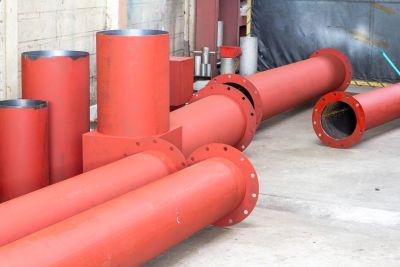
WHY SOIL CORROSIVITY MATTERS FOR DUCTILE-IRON PIPE
Buried ductile-iron water mains are exposed to continuously changing soil conditions.
Corrosion risk may be influenced by:
- Low soil resistivity
- Acidic or highly alkaline pH
- Anaerobic soil conditions
- Sulfide-producing bacteria
- Persistent moisture
- Poor drainage
- Soil heterogeneity
- Stray direct current
- Mine waste, cinders, peat or organic soil
- Existing corrosion history in the area
A corrosive soil environment can contribute to:
- Localized external corrosion
- Pitting
- Pipe-wall loss
- Premature leakage
- Water-main failure
- Increased maintenance costs
- Reduced service life
AWWA Appendix A combines several indicators because no single result completely characterizes the corrosion environment.

AWWA C105 APPENDIX A / TESTING PACKAGE
1. Water-Saturated Soil-Box Resistivity
Soil resistivity measures the resistance of the soil to the flow of electrical current.
Low-resistivity soil generally allows corrosion currents to flow more readily and may therefore represent a more aggressive environment for buried metallic infrastructure.
Appendix A identifies three possible resistivity approaches:
- Four-pin field measurement
- Single-probe field measurement
- Water-saturated soil-box laboratory measurement
For laboratory evaluation, the soil is brought to a water-saturated condition and measured using a soil-resistance meter and soil box. The Appendix notes that saturated testing is useful because the soil may not be naturally wet when sampled, while the buried pipe may experience saturated conditions during part of its service life.
Why Saturated Resistivity Is Important
Soil resistivity can change substantially with:
- Moisture content
- Temperature
- Dissolved salts
- Soil texture
- Compaction
- Groundwater exposure
Appendix A recommends interpreting resistivity using the lowest meaningful result, while considering the soil’s typical moisture condition and the method used to obtain the measurement.

2. SOIL pH
Soil pH provides information about acidity, alkalinity and chemical conditions that may influence corrosion.
Appendix A identifies several important pH ranges:
- pH 0–4: strongly acidic soil, often associated with elevated corrosion rates
- pH 6.5–7.5: conditions may be favourable for sulfate-reducing activity
- pH above 8.5: may indicate high dissolved-salt content and correspondingly low resistivity
The Appendix describes direct pH measurement using a calibrated combination electrode inserted into the soil sample.

3. OXIDATION-REDUCTION POTENTIAL
Evaluating Aerobic and Anaerobic Soil Conditions
Oxidation-reduction potential, commonly called redox potential or ORP, helps determine whether the soil is predominantly aerated or anaerobic.
This is important because sulfate-reducing bacteria typically develop under oxygen-deficient conditions. These microorganisms may produce sulfides and contribute to a corrosive environment around buried iron pipe.
Appendix A interprets redox potential approximately as follows:
- Greater than +100 mV: sufficiently aerated conditions
- 0 to +100 mV: possible transitional or anaerobic conditions
- Negative potential: definite anaerobic conditions favourable to sulfate-reducing activity
The standard describes measurement using a pH/mV meter and a combination ORP electrode inserted into the soil sample. It also warns that exposure to air may rapidly alter the redox potential of a freshly excavated soil. Redox testing should therefore be performed as soon as practicable after sampling.

4. QUALITATIVE SULFIDE TEST
Detection of Conditions Associated with Sulfate-Reducing Bacteria
A positive sulfide reaction may indicate a potential corrosion problem caused by sulfate-reducing bacteria.
Appendix A describes a qualitative sodium azide–iodine test. In this procedure, a reagent containing sodium azide and iodine is introduced to a soil sample.
Sulfides catalyze the reaction, producing nitrogen gas:
- Strong bubbling or foaming indicates a positive sulfide result
- Slight bubbling indicates a trace result
- No reaction indicates a negative result
The test is qualitative rather than a quantitative determination of total sulfur or sulfate concentration.
SULFIDE VS SULFATE: AN IMPORTANT DISTINCTION
These terms should not be confused.
Sulfide
Sulfide may be produced under anaerobic conditions by sulfate-reducing microorganisms. AWWA Appendix A uses a qualitative sulfide reaction as part of the soil-corrosivity evaluation.
Sulfate
Sulfate is an oxidized sulfur species commonly present in soil and groundwater. It may serve as a nutrient source for sulfate-reducing bacteria under favourable anaerobic conditions.
Appendix A.1 does not assign scoring points based directly on a quantitative sulfate concentration.
Therefore, quantitative sulfate analysis may be useful as a complementary investigation, but it should not be substituted for the Appendix A sulfide test without clearly identifying the deviation.

5. MOISTURE-CONDITION ASSESSMENT
Moisture is one of the most important factors affecting buried-pipe corrosion.
Appendix A does not require a precise gravimetric moisture percentage for its scoring system. Instead, it uses a relative assessment based on the prevailing field condition.
Optional Laboratory Moisture Content
Lab-Elite may also determine gravimetric moisture content as a complementary measurement.
However, the numerical moisture percentage should not automatically replace the AWWA field classification because:
- A submitted sample may dry during transport
- One sample may not represent seasonal conditions
- Drainage and groundwater prevalence are site characteristics
- Appendix A scoring is based on the prevailing condition

AWWA C105 APPENDIX A / SCORING SYSTEM
Appendix A combines assigned points from the principal soil characteristics.
The principal scoring parameters are:
- Water-saturated soil-box resistivity
- pH
- Redox potential
- Sulfide reaction
- Prevailing moisture condition
The Appendix states that a total of 10 points or more indicates that the soil is corrosive to ductile-iron pipe and that protection is needed.
Important Scoring Note
For soil having a pH of 6.5–7.5, Appendix A assigns no base points. However, if sulfides are present and the redox potential is below +100 mV or negative, the table instructs the evaluator to add three points for that pH range.

OUR LABORATORY PROCESS
1. Project Review
Lab-Elite reviews:
- Pipe type
- Planned burial depth
- Sampling locations
- Project specification
- Requested tests
- Need for field ORP or resistivity measurements
2. Sample Reception
Samples are logged with:
- Project identification
- Sample number
- Sampling depth
- Location
- Date and time
- Reported moisture condition
- Container condition
3. Soil Preparation
Preparation is selected according to the parameter being measured.
Excessive drying, grinding or air exposure may alter:
- Moisture
- Redox potential
- Sulfides
- Resistivity
Therefore, a single generic preparation procedure should not automatically be applied to every test.
4. Analytical Testing
The selected package may include:
- Saturated soil-box resistivity
- Direct soil pH
- ORP
- Qualitative sulfides
- Gravimetric moisture content
- Soil description
5. Technical Review and Scoring
Results are reviewed and the applicable AWWA Table A.1 points are assigned.
6. Final Report
The report presents:
- Individual results
- Measurement conditions
- Assigned points
- Total score
- Method limitations
- Deviations
- Recommended complementary investigations

RECOMMENDED SAMPLE QUANTITY
For a complete Lab-Elite Appendix A package, a practical recommended submission is:
Approximately 1.5–2.0 kg of representative soil per sampling location
This quantity permits:
- Soil-box resistivity
- pH
- ORP
- Sulfide screening
- Moisture determination
- Soil description
- Repeat preparation if necessary
Additional material may be required for:
- Coarse or heterogeneous soil
- Replicate testing
- Particle-size analysis
- Chlorides and sulfates
- Organic content
- Additional geotechnical characterization
The exact quantity should be confirmed before sampling because the required mass depends on the soil-box volume and the number of requested determinations.

MATERIALS AND ENVIRONMENTS COMMONLY EVALUATED
- Native soil
- Clay
- Silt
- Sand
- Loam
- Engineered fill
- Organic soil
- Peat
- Muck
- Mine waste
- Industrial fill
- Soil surrounding existing water mains
- Backfill around ductile-iron pipe
- Soil from water-main replacement projects
- Soil from municipal infrastructure corridors

TYPICAL PROJECTS
- New municipal water mains
- Ductile-iron pipe replacement
- Water-treatment plant piping
- Pumping stations
- Transmission mains
- Industrial water systems
- Mining-site water infrastructure
- Rural and remote water networks
- Corrosion investigations
- Failure analysis
- Infrastructure-rehabilitation projects
- Evaluation of polyethylene encasement requirements
