WELCOME TO LAB-ELITE

  • Home
  • Services
    • Concrete & Cement Testing
    • Aggregate & Water Testing
    • Mining & Metallurgical
    • Materials Investigation
  • Capabilities
    • Instrumentation
    • Industries
  • Standards & Methods
    • ASTM C114
    • ASTM C1152
    • ASTM C1324
    • ASTM D3042
    • ASTM D4972
    • AASHTO T288
    • CSA A23.2-8B
    • CSA A23.2-15A
    • AWWA C105
    • IEEE STD 81
    • ASTM D4373
  • Price List
  • Request a Quote
  • FR
  • More
    • Home
    • Services
      • Concrete & Cement Testing
      • Aggregate & Water Testing
      • Mining & Metallurgical
      • Materials Investigation
    • Capabilities
      • Instrumentation
      • Industries
    • Standards & Methods
      • ASTM C114
      • ASTM C1152
      • ASTM C1324
      • ASTM D3042
      • ASTM D4972
      • AASHTO T288
      • CSA A23.2-8B
      • CSA A23.2-15A
      • AWWA C105
      • IEEE STD 81
      • ASTM D4373
    • Price List
    • Request a Quote
    • FR
  • Home
  • Services
    • Concrete & Cement Testing
    • Aggregate & Water Testing
    • Mining & Metallurgical
    • Materials Investigation
  • Capabilities
    • Instrumentation
    • Industries
  • Standards & Methods
    • ASTM C114
    • ASTM C1152
    • ASTM C1324
    • ASTM D3042
    • ASTM D4972
    • AASHTO T288
    • CSA A23.2-8B
    • CSA A23.2-15A
    • AWWA C105
    • IEEE STD 81
    • ASTM D4373
  • Price List
  • Request a Quote
  • FR

ASTM D3042

ASTM D3042 INSOLUBLE RESIDUE IN CARBONATE AGGREGATES

Lab-Elite provides ASTM D3042 insoluble residue testing for carbonate aggregates throughout Quebec and Canada. 

ASTM D3042 determines the percentage of acid-insoluble residue remaining after carbonate material is dissolved using hydrochloric acid. The test can be used for aggregate characterization, material evaluation and investigations involving the noncarbonate fraction of carbonate aggregates.

Our laboratory provides sample preparation, chemical testing and technical support for engineers, aggregate producers, contractors and infrastructure professionals.

 ASTM D3042 testing is commonly used for: 

  • Carbonate aggregate characterization 
  • Determination of insoluble residue 
  • Evaluation of noncarbonate constituents 
  • Aggregate source evaluation 
  • Pavement aggregate investigations 
  • Research and engineering studies  

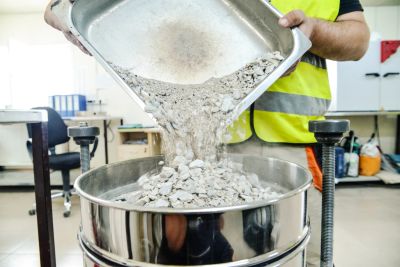
Person pouring crushed concrete into a sieve.

Why Choose Lab-Elite for ASTM D3042 Testing?

Flexible Testing Options Tailored to Your Project

At Lab-Elite, we recognize that not every project requires the same level of testing rigor. Unlike many laboratories that offer only a single testing approach, we provide two ASTM D3042 testing options, allowing our clients to balance technical requirements, turnaround time and cost.

Option 1 – Single Determination

A cost-effective solution for:

  • Internal quality control 
  • Research and development 
  • Preliminary investigations 
  • Process monitoring 
  • Projects where a single determination is specifically requested 

This option provides reliable carbonate content data while minimizing testing costs when strict ASTM compliance is not required.

Option 2 – ASTM D3042-17 Triplicate Determination (Section 7.2)

For projects requiring full compliance with ASTM D3042-17, Lab-Elite performs the analysis in triplicate, in accordance with Section 7.2 of the standard.

This approach offers:

  • Improved analytical precision 
  • Better repeatability 
  • Increased confidence in the reported result 
  • Compliance with official project specifications 
  • Enhanced quality assurance for engineering and contractual purposes 

Helping Clients Choose the Right Level of Testing

Our technical specialists work with each client to determine whether a single determination or a triplicate determination is the most appropriate approach based on:

  • Project objectives 
  • Applicable specifications 
  • Regulatory requirements 
  • Budget considerations 
  • Required level of confidence 

This flexible approach ensures clients receive the level of analytical rigor that best matches their technical and contractual needs.

The Lab-Elite Advantage

✔ Choice between single and triplicate determinations

✔ Full compliance with ASTM D3042-17 Section 7.2 when required

✔ Transparent pricing based on testing requirements

✔ Technical guidance before sample submission

✔ ISO 17025 quality management practices

✔ Fast turnaround times

✔ Experienced analytical chemists specialized in construction materials

A Better Value for Our Clients

Many laboratories offer only one ASTM D3042 testing option without distinguishing between routine analyses and full-standard determinations. At Lab-Elite, we clearly identify both approaches, allowing clients to select the most appropriate level of testing while ensuring technical transparency and cost efficiency.

Need Help ASTM D3042 testing option?

Need help selecting the appropriate ASTM D3042 testing option? Our technical team can help you determine whether a single determination or a triplicate determination is appropriate for your project specifications and quality requirements. 

Contact

WHY CARBONATE CONTENT IS IMPORTANT

 Carbonate minerals are commonly present in aggregates and geological materials used in construction.

Understanding carbonate content helps engineers better characterize materials and verify compliance with project specifications.

Carbonate content may influence:

  • aggregate classification 
  • material selection 
  • construction specifications 
  • engineering design considerations 
  • quality control programs 

Many transportation and infrastructure projects include carbonate requirements as part of aggregate acceptance criteria.

WHAT IS ASTM D3042 CARBONATE ANALYSIS?

ASTM D3042 is a standardized analytical procedure used to determine the carbonate content of aggregates, soils and geological materials.

The method is frequently used in construction and infrastructure projects where carbonate content is specified as part of material qualification and acceptance criteria.

The objective of ASTM D3042 is to quantify carbonate minerals present within a material, typically expressed as calcium carbonate equivalent.

Carbonate content investigations commonly support:

  • aggregate source evaluations 
  • specification compliance 
  • construction quality control 
  • material classification 
  • forensic investigations 
  • durability studies

COMMON CARBONATE MINERALS FOUND IN AGGREGATES

Aggregates may contain varying proportions of carbonate minerals depending on the geological source.

Typical carbonate minerals include:

  • Calcite (CaCO₃) 
  • Dolomite (CaMg(CO₃)₂) 
  • Magnesite 
  • Siderite 

Carbonate-bearing aggregates are common throughout many regions of Quebec and Canada.

Understanding mineral composition helps support aggregate characterization and engineering decision-making.

AGGREGATE SOURCE CHARACTERIZATION

Different aggregate sources may exhibit significantly different carbonate contents.

Carbonate testing can assist in:

  • source qualification 
  • quality assurance programs 
  • aggregate comparisons 
  • material certification 
  • long-term supply management 

ASTM D3042 provides a practical tool for characterizing aggregate deposits and production materials.

QUALITY CONTROL AND SPECIFICATION COMPLIANCE

 Many infrastructure projects require aggregate testing as part of quality control programs.

ASTM D3042 results may support:

  • project acceptance requirements 
  • supplier qualification 
  • material certification 
  • quality management systems 
  • contract compliance 

Routine carbonate testing can help verify consistency of production materials over time.

ENGINEERING APPLICATIONS OF ASTM D3042

 Carbonate content data may be used to support:

Transportation Infrastructure

  • highways 
  • bridges 
  • transportation corridors 

Municipal Infrastructure

  • roads 
  • utilities 
  • public works 

Concrete Production

  • aggregate characterization 
  • material qualification 

Aggregate Production

  • source evaluation 
  • production quality control

GEOLOGICAL AND MINERALOGICAL INVESTIGATIONS

Carbonate analysis is frequently combined with other analytical techniques to provide a more complete understanding of material composition.

At LAB-ELITE, ASTM D3042 investigations may be supplemented by:

  • XRD mineralogical characterization 
  • XRF elemental characterization 
  • petrographic examination 
  • sulfate analysis 
  • chloride analysis 

Combining analytical techniques often provides valuable insight into aggregate composition and performance.

Suggested image:

  • XRD diffraction pattern 
  • Aggregate thin section 
  • Mineralogical characterization

ASTM D3042 ANALYTICAL SERVICES

At LAB-ELITE, ASTM D3042 projects may include:

  • aggregate carbonate analysis 
  • source characterization 
  • material qualification 
  • quality control testing 
  • forensic investigations 
  • engineering support 
  • specification compliance evaluations 
  • research projects 

ASTM D3042 results may be used independently or combined with:

  • ASTM C1324 
  • sulfate analysis 
  • chloride analysis 
  • XRF characterization 
  • XRD characterization 
  • petrographic examination

COMMON APPLICATIONS OF ASTM D3042

ASTM D3042 testing is frequently requested by:

  • aggregate producers 
  • consulting engineers 
  • municipalities 
  • contractors 
  • transportation agencies 
  • infrastructure owners 
  • laboratories 
  • research organizations 

Typical projects include:

  • aggregate qualification 
  • source approval programs 
  • quality control testing 
  • infrastructure projects 
  • municipal construction 
  • forensic engineering investigations

FAQ SECTION

What is ASTM D3042 used for?

ASTM D3042 is used to determine carbonate content in aggregates, soils and geological materials.

Why measure carbonate content?

Carbonate content is often used to characterize materials, verify compliance with specifications and support engineering evaluations.

What materials can be tested?

Typical materials include aggregates, crushed stone, granular materials, soils and geological samples.

Can ASTM D3042 be used for quality control?

Yes. ASTM D3042 is frequently used by aggregate producers and engineering firms as part of quality control and material qualification programs.

Can ASTM D3042 be combined with XRD or XRF?

Yes. Combining carbonate analysis with XRD and XRF can provide a more complete understanding of material composition.

Who typically requests ASTM D3042 testing?

Aggregate producers, engineering consultants, municipalities, contractors, transportation agencies and infrastructure owners.

Do you serve all of Quebec and Canada?

Yes. LAB-ELITE provides ASTM D3042 analytical services for clients throughout Quebec and Canada.

Find out more

ASTM D3042 vs ASTM C1324

 Although both methods may be used to evaluate carbonate content, ASTM D3042 is commonly applied to aggregates and geological materials, while ASTM C1324 is frequently associated with carbonate determination in construction materials and engineering investigations.

Depending on project requirements, our technical team can help determine the most appropriate analytical approach.

ASTM D3042 Carbonate Content Testing for Aggregates and Construction Materials

ASTM D3042 is a recognized analytical method used to determine the carbonate content of aggregates, soils and geological materials. Carbonate content data is commonly used for aggregate characterization, material qualification, specification compliance and engineering investigations.

LAB-ELITE provides ASTM D3042 carbonate testing services for aggregate producers, consulting engineers, municipalities, contractors and infrastructure owners throughout Quebec and Canada.

Typical Applications

  • Aggregate source qualification 
  • Material characterization 
  • Construction projects 
  • Transportation infrastructure 
  • Municipal infrastructure 
  • Quality control programs 
  • Engineering investigations 
  • Specification compliance

Aggregate Carbonate Analysis for Engineering and Infrastructure Projects

Understanding carbonate content is an important part of aggregate evaluation and quality assurance programs.

ASTM D3042 testing may support:

  • Aggregate acceptance testing 
  • Quarry source evaluation 
  • Granular material characterization 
  • Durability investigations 
  • Research projects 
  • Construction material qualification 

Carbonate content data can be used together with mineralogical and elemental analyses to provide a more complete understanding of aggregate composition and performance.

Carbonate Content, Aggregate Characterization and Material Performance

Aggregate performance is influenced by mineralogical composition and carbonate content. ASTM D3042 provides a standardized approach for quantifying carbonate minerals commonly found in aggregates and geological materials.

For comprehensive material characterization, ASTM D3042 testing may be combined with:

  • XRD mineralogical analysis 
  • XRF elemental analysis 
  • Petrographic examination 
  • Sulfate analysis 
  • Chloride analysis 
  • Alkali analysis 

LAB-ELITE offers integrated analytical testing programs to support construction, infrastructure and mining projects.

Lab-Elite

230 Rue Bernard Belleau, Laval, Quebec H7V 4A9, Canada

450-686-0111

Copyright © 2020 Lab-Elite - All Rights Reserved.

Powered by

Cookie Policy

This website uses cookies. By continuing to use this site, you accept our use of cookies.

RefuseAccept & Close