WELCOME TO LAB-ELITE

  • Home
  • Services
    • Concrete & Cement Testing
    • Aggregate & Water Testing
    • Mining & Metallurgical
    • Materials Investigation
  • Capabilities
    • Instrumentation
    • Industries
  • Standards & Methods
    • ASTM C114
    • ASTM C1152
    • ASTM C1324
    • ASTM D3042
    • ASTM D4972
    • AASHTO T288
    • CSA A23.2-8B
    • CSA A23.2-15A
    • AWWA C105
    • IEEE STD 81
    • ASTM D4373
  • Price List
  • Request a Quote
  • FR
  • More
    • Home
    • Services
      • Concrete & Cement Testing
      • Aggregate & Water Testing
      • Mining & Metallurgical
      • Materials Investigation
    • Capabilities
      • Instrumentation
      • Industries
    • Standards & Methods
      • ASTM C114
      • ASTM C1152
      • ASTM C1324
      • ASTM D3042
      • ASTM D4972
      • AASHTO T288
      • CSA A23.2-8B
      • CSA A23.2-15A
      • AWWA C105
      • IEEE STD 81
      • ASTM D4373
    • Price List
    • Request a Quote
    • FR
  • Home
  • Services
    • Concrete & Cement Testing
    • Aggregate & Water Testing
    • Mining & Metallurgical
    • Materials Investigation
  • Capabilities
    • Instrumentation
    • Industries
  • Standards & Methods
    • ASTM C114
    • ASTM C1152
    • ASTM C1324
    • ASTM D3042
    • ASTM D4972
    • AASHTO T288
    • CSA A23.2-8B
    • CSA A23.2-15A
    • AWWA C105
    • IEEE STD 81
    • ASTM D4373
  • Price List
  • Request a Quote
  • FR

IEEE STD 81-2025

IEEE STD 81-2025 AGGREGATE RESISTIVITY TESTING FOR ELECTRICAL SUBSTATIONS

LAB-ELITE provides IEEE Std 81-2025 aggregate resistivity testing for crushed stone, coarse aggregate and aggregate mixtures used as surface layers in electrical substations and other grounding applications throughout Quebec and Canada.

IEEE Std 81-2025 provides guidance for evaluating the electrical characteristics of grounding systems and includes specific procedures for the laboratory measurement of aggregate electrical resistivity. The laboratory method described in Annex F evaluates the resistivity of coarse aggregates and aggregate mixtures under controlled moisture and density conditions.

Aggregate resistivity is an important parameter in the design and assessment of substation grounding systems because the surface aggregate provides an electrically resistive layer between personnel and the ground. 

Our laboratory provides resistivity measurements to support:

  • electrical substation grounding design 
  • touch and step voltage assessments 
  • crushed stone qualification 
  • surface aggregate selection 
  • new substation construction 
  • existing substation evaluations 
  • grounding system engineering studies 
  • aggregate source and quarry qualification
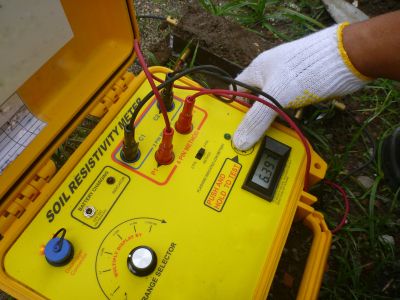
Mesureur de résistivité du sol en cours d'utilisation.

WHAT IS IEEE STD 81-2025 AGGREGATE RESISTIVITY TESTING?

IEEE Std 81-2025 is the IEEE Guide for Measuring Earth Resistivity, Ground Impedance, and Earth Surface Potentials of a Grounding System. The 2025 edition includes dedicated guidance for crushed aggregate resistivity testing in Clause 11, aggregate sampling in Annex E and aggregate resistivity test methods in Annex F. 

Annex F describes a laboratory procedure for measuring the electrical resistivity of coarse aggregate and aggregate mixtures used as yard surfacing in electrical substations. Testing can account for different aggregate classifications, moisture conditions and unit densities, with results reported in ohm-metres (Ω·m). 

The laboratory test is based on placing aggregate in a nonconductive resistivity test vessel equipped with electrodes. Electrical resistance is measured across the sample and converted to resistivity based on the geometry of the test cell.

WHY AGGREGATE RESISTIVITY MATTERS

Crushed stone used at electrical substations is not simply a structural or drainage material. It also serves as an electrically resistive surface layer between personnel and the underlying ground.

IEEE Std 81 recognizes that aggregate resistivity is significant both for the design of grounding systems at new substations and for evaluating conditions at existing facilities. 

Higher Aggregate Resistivity

Generally provides:

  • greater electrical isolation from the underlying soil 
  • increased surface-layer resistance 
  • improved mitigation of touch and step voltage exposure 
  • greater contribution to personnel safety assumptions used in grounding design 

Lower Aggregate Resistivity

May result from:

  • moisture 
  • fine particles 
  • contamination 
  • salts or other conductive materials 
  • aggregate degradation 
  • compaction 
  • mixing with underlying soil 

IEEE Std 81 specifically notes that contamination, traffic, organic matter, wind-blown salt and other environmental factors can progressively reduce surface-layer resistivity.

IEEE STD 81 AND SUBSTATION GROUNDING DESIGN

Surface aggregate resistivity can have an important influence on grounding-system safety calculations.

During a ground fault, personnel within or near a substation may be exposed to electrical potential differences. A sufficiently resistive crushed-stone surface layer can increase the effective resistance between a person and earth and therefore contributes to the evaluation of permissible touch and step voltages.

For this reason, aggregate resistivity values may be used by grounding engineers when designing or verifying grounding systems.

IEEE Std 81-2025 also identifies IEEE Std 80 – IEEE Guide for Safety in AC Substation Grounding as its normative reference. 

CRUSHED AGGREGATE QUALIFICATION

IEEE Std 81 emphasizes that generic or published resistivity values should not replace testing when a specific aggregate is intended for a grounding design.

Where a design requires a crushed aggregate layer to mitigate touch and step voltages, the standard identifies testing of the aggregate intended for installation as best practice, with the measured resistivity preferably exceeding the design value with an appropriate margin for potential degradation over time. 

LAB-ELITE can therefore perform testing for:

  • proposed quarry materials 
  • crushed stone prior to construction 
  • aggregate delivered to a project 
  • existing substation surface aggregate 
  • replacement aggregate 
  • comparative evaluation of aggregate sources 

This allows engineers and asset owners to verify the electrical properties of the actual material being considered for the project.

MATERIALS COMMONLY TESTED

LAB-ELITE performs IEEE Std 81 aggregate resistivity testing on materials including:

Open-Graded Aggregates

  • crushed stone 
  • clear stone 
  • washed stone 
  • coarse substation surfacing aggregate 

IEEE describes open-graded coarse aggregate as material having significant void space permitting water to drain freely and generally containing less than 10% passing the 4.75 mm sieve. 

Dense-Graded Aggregates

  • dense graded crushed stone 
  • granular materials containing fines 
  • compacted aggregate systems 

Mixed-Graded Aggregates

  • existing surface aggregate containing fines 
  • partially contaminated aggregate 
  • aged or weathered substation aggregate 

The distinction is important because IEEE Std 81 provides different preparation and compaction approaches depending on the aggregate classification. 

LABORATORY TESTING ACCORDING TO IEEE STD 81-2025 ANNEX F

The IEEE laboratory method uses a rigid, nonconductive resistivity test cell equipped with conductive electrodes.

The aggregate is placed into the test vessel at a predetermined density and moisture condition. A low-frequency AC or switched-polarity DC current is applied across the opposing electrodes. Voltage and current are measured, resistance is determined using Ohm's law, and electrical resistivity is calculated from the resistance and geometry of the test vessel:

ρ = R × A / L

where:

ρ = electrical resistivity (Ω·m)
R = measured electrical resistance (Ω)
A = cross-sectional area of the test cell (m²)
L = distance between electrodes (m)

This is the fundamental measurement principle specified in Annex F. 

The test cell must also be appropriately sized relative to the aggregate: IEEE indicates that its smallest cross-sectional dimension should be at least three times the nominal maximum particle size, and not less than 150 mm. 

EFFECT OF MOISTURE ON AGGREGATE RESISTIVITY

Moisture is one of the principal variables affecting the electrical resistivity of crushed aggregate.

IEEE Std 81 allows aggregate resistivity to be evaluated at different moisture conditions. Depending on the engineering requirements, testing can be performed under conditions representative of:

  • dry aggregate 
  • specified moisture content 
  • saturated aggregate 
  • intermediate moisture conditions 
  • in-service or project-specific conditions 

IEEE also allows the water used for conditioning to represent local environmental conditions. Tap water is generally acceptable unless another water resistivity is specified by the requester. 

Important: IEEE Std 81 specifically cautions that the saturated resistivity measured by the laboratory procedure does not necessarily represent the absolute minimum resistivity of the aggregate. 

I would include that sentence because it makes the page technically stronger and avoids overstating what the test establishes

AGGREGATE SAMPLING – IEEE STD 81 ANNEX E

Representative sampling is essential because aggregate segregation, degradation and contamination can significantly affect measured resistivity.

IEEE Std 81 Annex E provides recommendations for obtaining representative aggregate samples from:

  • quarry or production stockpiles 
  • material delivered to site 
  • truck dumps 
  • existing electrical substations 
  • in-service surface aggregate 

Samples should generally not be washed after collection, unless specifically required by the testing specification, because washing could modify the characteristics of the material being evaluated. 

When sampling existing substations, particular care should be taken to avoid accidentally incorporating underlying subgrade soil unless this material is intentionally part of the investigation.

IEEE STD 81 TEST REPORT

Depending on the requested test program, the laboratory report may include:

  • aggregate description and classification 
  • sample source or sampling location 
  • test-cell orientation 
  • moisture condition 
  • measured resistance (Ω) 
  • calculated electrical resistivity (Ω·m) 
  • water used for conditioning 
  • water conductivity/resistivity 
  • relevant observations 
  • deviations from the requested test procedure

COMMON APPLICATIONS

IEEE Std 81 aggregate resistivity testing is particularly relevant for:

  • electrical substations 
  • high-voltage substations 
  • transmission infrastructure 
  • utility facilities 
  • renewable-energy substations 
  • wind farm substations 
  • solar farm substations 
  • industrial electrical installations 
  • grounding-system upgrades 
  • substation rehabilitation projects 

Testing may be requested by electrical engineers, grounding-system designers, utilities, EPC contractors, consulting engineers, aggregate suppliers and infrastructure owners.

OUR IEEE STD 81 TESTING SERVICES

LAB-ELITE provides laboratory testing to support aggregate selection and grounding-system engineering projects.

Services may include:

  • IEEE Std 81-2025 aggregate resistivity testing 
  • dry aggregate resistivity 
  • saturated/wet-condition resistivity 
  • drained-condition evaluation where specified 
  • aggregate source qualification 
  • comparative testing of multiple aggregates 
  • aggregate characterization 
  • water conductivity measurement 
  • project-specific resistivity testing programs 

Test conditions can be established with the client or grounding engineer according to the intended application and design requirements.

FAQ SECTION


What is IEEE Std 81?

IEEE Std 81 is the IEEE guide covering practical methods for measuring electrical characteristics associated with grounding systems, including earth resistivity, grounding-system resistance and impedance, surface potentials and crushed aggregate resistivity. 

Which part of IEEE Std 81 covers crushed aggregate resistivity?

Clause 11 addresses crushed aggregate resistivity testing. Annex E covers aggregate sampling and Annex F covers aggregate resistivity test methods. 

Why is crushed stone resistivity important in substations?

Crushed aggregate provides an electrically resistive surface layer between personnel and earth. Its resistivity therefore affects assumptions used in grounding-system safety evaluations and design. 

Can LAB-ELITE test aggregate before it is installed?

Yes. Aggregate from a quarry, stockpile or material proposed for a new substation can be tested before installation to determine its electrical resistivity.

Can existing substation aggregate be tested?

Yes. Representative samples can be collected from an existing substation. IEEE Std 81 Annex E provides guidance for in-situ sampling intended to account for variability, segregation and contamination. 

Should the aggregate be washed before sending it to the laboratory?

No, unless specifically requested. IEEE Std 81 recommends that aggregate generally not be washed after collection because this could alter the characteristics of the sample. 

In what units is aggregate resistivity reported?

Electrical resistivity is reported in ohm-metres (Ω·m). 

Does LAB-ELITE provide IEEE Std 81 testing throughout Canada?

Yes. Samples can be submitted to LAB-ELITE for laboratory aggregate resistivity testing from projects throughout Quebec and Canada.

Find out more

Lab-Elite

230 Rue Bernard Belleau, Laval, Quebec H7V 4A9, Canada

450-686-0111

Copyright © 2020 Lab-Elite - All Rights Reserved.

Powered by

Cookie Policy

This website uses cookies. By continuing to use this site, you accept our use of cookies.

RefuseAccept & Close